Taxes · 10 min read
What Is Tax-Free Retirement Income and How Do You Actually Get It?
Tax free retirement income is money you can spend in retirement without owing federal income tax on it — if you know what qualifies and what only looks tax-free.
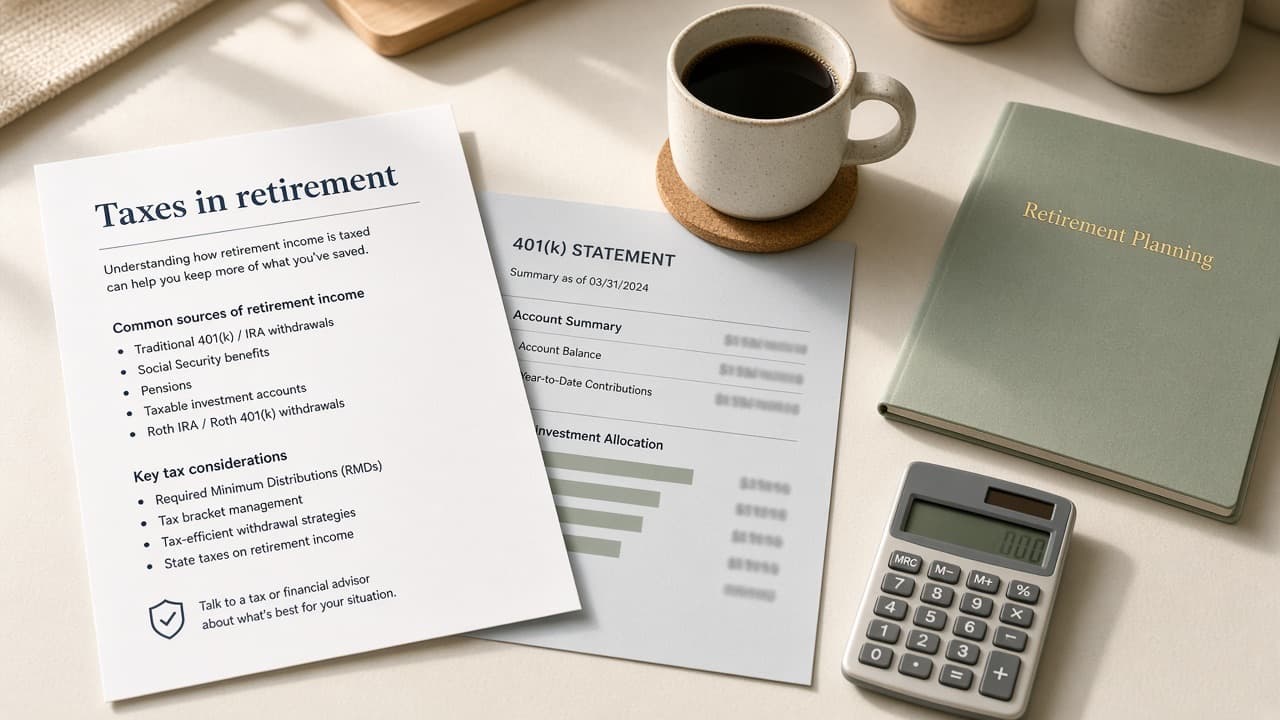
What counts as tax free retirement income?
“Tax-free” almost always means free of federal income tax. State rules, Medicare premiums, and the way Social Security gets taxed can still take a bite.
Roth IRA and Roth 401(k) withdrawals: you fund with after-tax money, so qualified withdrawals come out tax-free, growth included. “Qualified” generally means you’re 59½ or older and the account has been open at least five years. Roth IRAs have no required minimum distributions during your lifetime; since 2024, Roth 401(k)s don’t either.
HSA money: contributions are deductible, growth isn’t taxed, and withdrawals for qualified medical costs come out tax-free at any age. After 65 you can take money out for non-medical reasons with ordinary income tax and no 20% penalty. You need a high-deductible health plan while contributing.
Municipal bonds and tax free bond funds: interest is exempt from federal income tax and often from state tax if the bonds come from your own state. Fund prices still move with rates, and tax-exempt interest can affect how Social Security is taxed.
Social Security (sometimes): up to 85% can be taxable depending on “combined income.” Below $25,000 single or $32,000 married filing jointly, benefits generally aren’t taxed.
Life insurance: death benefits are generally income-tax-free to beneficiaries. Cash value grows tax-deferred; loans are generally not taxed while the policy stays in force and isn’t a MEC. Lapse with outstanding loans can trigger tax.
Tax-free vs. tax-deferred
Tax-deferred means you pay later — traditional 401(k) and IRA withdrawals are generally ordinary income. Tax-free means qualified withdrawals don’t add to the bill. In the 22% bracket, $1,000 from traditional might net about $780; from a Roth you keep the full $1,000.
Tax free retirement strategies that actually work
1. Take the full employer match first.
2. Add Roth contributions where eligible.
3. Fund an HSA if you qualify.
4. Use low-income years to convert traditional money to Roth at a lower rate.
5. Only then ask whether permanent life insurance belongs — for many people it shouldn’t be step one.
For many households the best tax free retirement income source is whichever one you can fund consistently: often Roth, sometimes HSA, with insurance as a complement.
Tax free retirement income for seniors on a tight budget
If most income is Social Security plus a small pension, you may already owe little. SSI and VA disability compensation are also non-taxable for many recipients. The IRS VITA program and Tax Counseling for the Elderly (60+) offer free return preparation at local sites.
Frequently asked questions
- Which retirement income is actually tax-free?
- Qualified Roth withdrawals, HSA money spent on medical costs, federal interest from municipal bonds, life insurance death benefits, and sometimes Social Security. SSI and VA disability are also untaxed. Each has conditions.
- Is Social Security ever tax-free?
- Yes. If combined income stays under $25,000 (single) or $32,000 (married filing jointly), benefits generally aren’t taxed.
- Are Roth IRA withdrawals always tax-free?
- Contributions can come out anytime. Earnings need you to be 59½ and the account five years old; early earnings can owe tax plus a 10% penalty.
- What is the difference between tax-free and tax-deferred?
- Tax-deferred: you pay later when you withdraw. Tax-free: you don’t pay on qualified withdrawals at all.
Educational information only. This article is not financial, tax, or legal advice and does not recommend any product.